Basilica of San Vitale
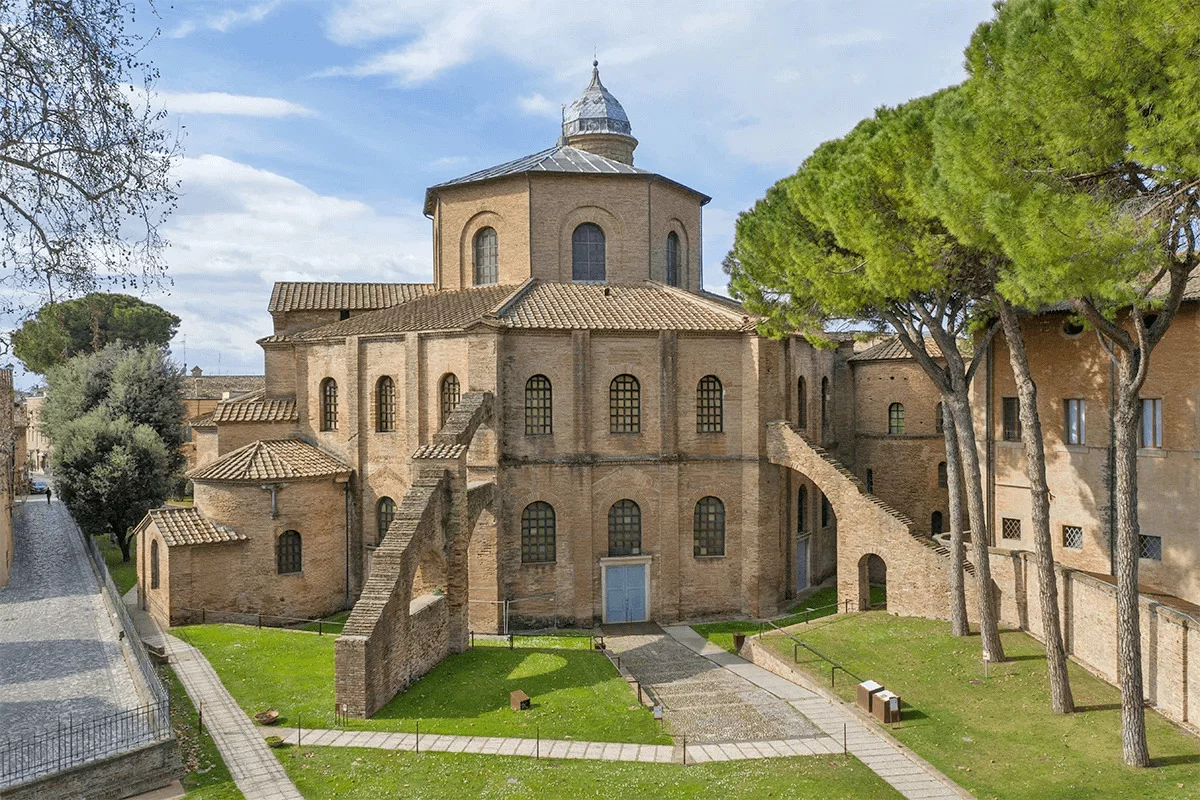
Architect: N/A (commissioned by Ecclesius of Ravenna)
Material: Stone, Marble
Relative/Absolute Date: 526
Culture: Byzantine
Scale: N/A
Current Location: Ravenna, Italy
The Basilica of San Vitale was a building of utmost importance in the context of Byzantine architecturals, especially considering Ravenna's role in the peak of Byzantine history under the rule of Theodoric the Great and then later during Justinian I's reign. Commissioned in 526 by the bishop of Ravenna and consecrated by the archbishop Maximian in 548, San Vitale is the culmination of different sources of inspiration (Castex 2008, 152). Named after Saint Vitalis, a Christian slave that was martyred in Bologna, Italy, the Basilica hails from both Italian masonry and eastern Christian influence in its albeit unorthodox central-plan layout (Hayes 2008, 430; Castex 2008, 153).
As far as historic monuments go, this Basilica is one of the most intact examples of Byzantine architecture and especially of their mosaic work. Unlike Sant'Apollinare Nuovo, also residing in Ravenna, it still retains some imagery of Byzantine notability in the apse with the inclusion of Justinian I, the Empress Theodora, and the Archbishop Maximian - rendered entirely in that characteristic Byzantine style with the towering, unconventionally skinny renditions with poses that can be seen as ceremonial (Hayes 2008, 432). The completeness of the Byzantine mosaics in particular could be likened to the fact that Theodoric is notably absent in this church, and also that Justinian had incorporated aspects of Christian imagery within as well (Castex 2008, 153).