Hagia Sophia
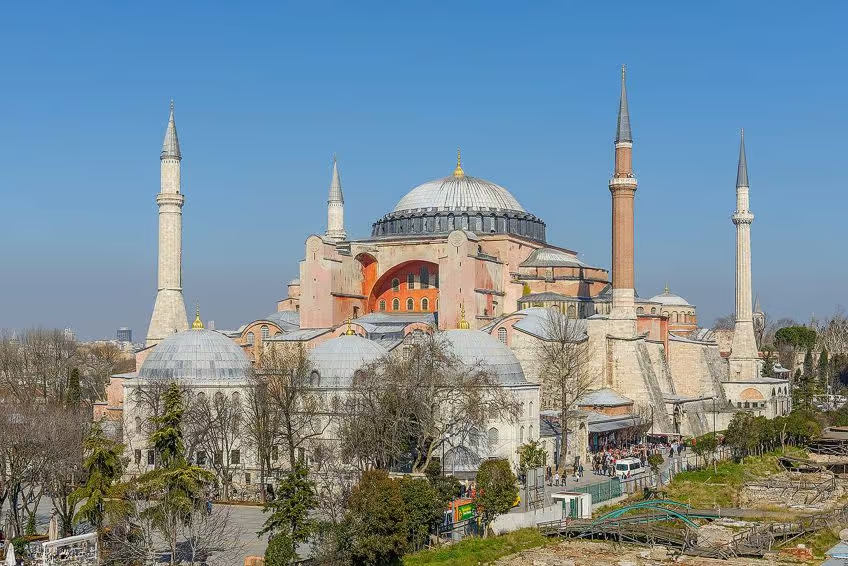 Architect: Isidore of Miletus, Anthemius of Trailes
Material: Stone, Gold
Relative/Absolute Date: 532 - 537
Culture: Byzantine
Scale: 82m x 73m x 55m
Current Location: Istanbul, Turkey
It is of no exaggeration to describe the Hagia Sophia of Constantinople as both the synthesis of and precedent of Byzantine character. Considered the largest dome structure in the world at the time of its creation, Justinian I commissioned its creation shortly after the riots in Nika of 532 when the previous basilica was razed to the ground (Cohen 2015). He would entrust this task to two mathematicians with no formal education in architectural design, Isidore of Miletus and Anthemius of Tralles. They in turn, in accordance with Justinian I’s desires for a grander basilica, actually invent a new method of construction for the dome – pendentives, which are triangular slices of a sphere and are used to be able to better distribute a dome structure’s weight over a square foundation. From the inside, it has been described as an almost weightless, floating structure – a gateway into Heaven itself.
The dome remained an important symbol of Byzantine ingenuity long after Constantinople’s absorption into the Ottoman Empire. Due to its important position in the Empire as a center of cultural and mercantile importance, many iconic aspects of Constantinople, now Istanbul, was exchanged between Christianity and Islam (Stephenson, et al. 2005, 169). In its conversion from a Christian church into a mosque, Hagia Sophia represented this preservation and interchange of ideas into a new era.